Roll or Slide?
Quick Activity Snapshot
- Age Range
- Ages 2–3
- Prep Time
- 5 minutes
- Skills Practiced
- Predicting and testing how objects move
- Materials
- A gentle book or tray ramp, a towel, a ball, and a block
Age ranges are suggestions, not developmental milestones or standards. Choose the setup for this child, and stop whenever needed.
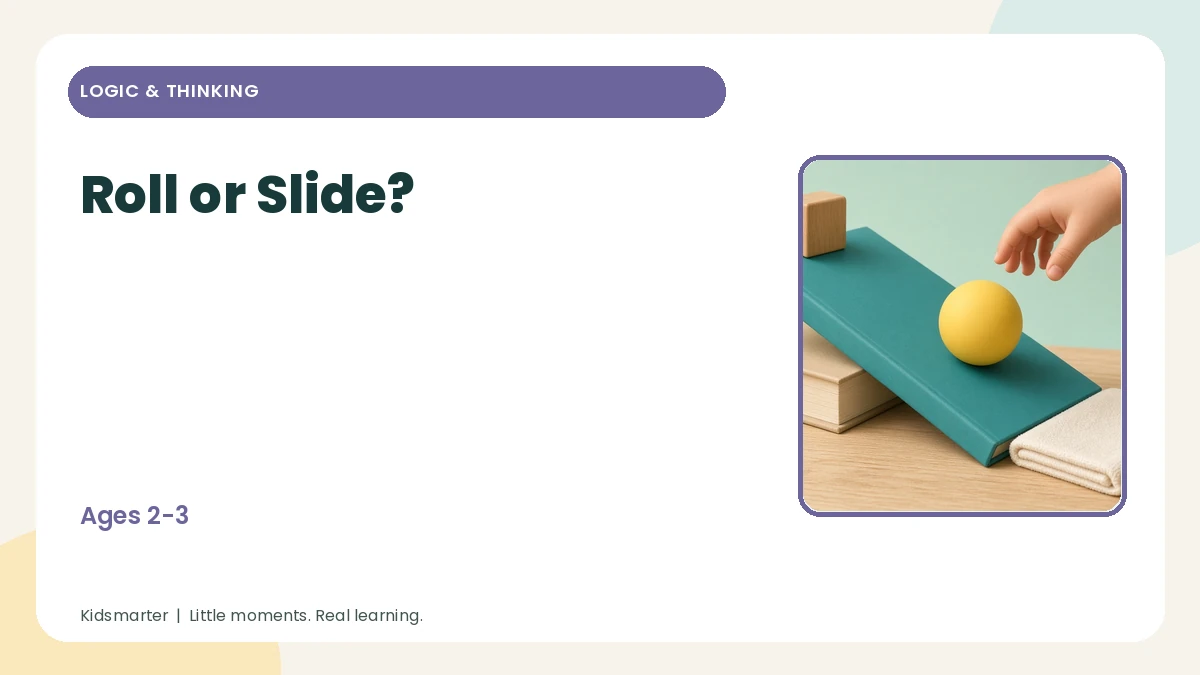
A gentle ramp can turn a few everyday objects into a short test: will this one roll, or will it slide? You and your child try it and talk about what happens. This is a small home experiment, not a formal science lesson, and a surprising result is useful, not a failing.
Materials You’ll Need
- A hardcover book or a baking sheet, plus a second book or a block to raise one end into a shallow ramp
- A folded towel or a soft cloth at the low end, used as a catch
- Three large, unbreakable objects that look different from one another, such as a rubber ball too large to swallow, a rectangular wooden block or a closed board book, and a large plastic cup on its side
Keep the tilt shallow so objects move slowly and land on the towel. Do not use glass, marbles, tiny balls, or anything that can fit entirely in a child’s mouth. Do not use food or drinks on the ramp. An adult builds the ramp before the child joins, and the child does not need to lift a heavy stack of books.
Step-by-Step How to Play
-
Set the ramp on a table or a clear patch of floor, with the towel at the bottom. Show the three objects and say, “We can try each one. Some may roll. Some may slide.”
-
Hold one object at the top. You may ask, “Do you think it will roll or slide?” A word, a point, a shrug, or “try it” all count. Then let it go, or let your child release it if they can do so gently.
-
Watch together and name what happened: “The ball rolled. The block slid.” If a cube stays put, say that too. You may make two piles: ones that rolled, and ones that slid or stayed.
-
Try the remaining objects the same way. If the result surprises you, try that object once more rather than correcting your child. The second try is part of the looking, not a test they have to pass.
-
When the three objects have had a turn, put the ramp away together. There is no score and no required number of trials.
Small Details That Make This Activity Work
Stay close enough to catch anything that bounces past the towel. Keep the language short and tied to what you both just saw. If your child wants only to send the ball again and again, you can stay with the ball and talk about rolling, or you can stop. This is not a weight-comparison game, not a lid-fitting game, and not a mystery bag: you are looking, together, at how each object moves on the same gentle slope.
Why This Activity Helps
Trying an idea and watching what happens is one everyday way to explore how objects move. NAEYC’s article on tinkering, making, and early STEM describes children exploring the physical properties of materials, asking questions, and testing ideas, and it includes an example of talking about a roller on a ramp. That article is written for educators about tinkering and engineering experiences; it does not evaluate this three-object home ramp, and it is not a science curriculum for this game. Sending a ball down a book is not evidence of later science achievement.
Easy Ways to Adapt by Age
Make It Simpler
Use only the ball and the block, and skip the prediction question. You can simply say “Let’s try it” and name roll or slide after each turn. Hold the object together as you release it.
Ready for a Challenge
Invite a prediction before each release, then check it against what happens. You may make the ramp a little steeper, still shallow and still caught by the towel, and see whether the block now slides. Do not make the slope steep enough for objects to fly, and stop if the extra change turns the game into throwing.
Parent Tip & Safety Note
Supervise the whole time. Keep the ramp shallow, use a towel catch, and choose only large, unbreakable objects. Do not use glass, metal cans with sharp rims, marbles, small cars launched at people, or anything a child could swallow. Do not stand on books or trays, and do not place the ramp at the top of stairs. Keep the objects from being thrown toward faces or windows. If a younger sibling is nearby, keep small household items they might mouth out of reach. Stop if your child is finished, frustrated, or more interested in building with the books than testing the ramp.
Explore more activities in this category or free printable games.
For talk about exploring materials, asking questions, and testing ideas, including an example of a roller on a ramp, see NAEYC’s Small Hands, Big Ideas: Exploring STEM Through Tinkering, Making, and Engineering. That article is about early STEM and tinkering in learning settings; it does not test this three-object home game. For choking hazards when choosing objects, see HealthyChildren.org’s Choking Prevention for Babies & Children. That guidance is about safer objects and eating, not about teaching science.