First, Second, Third in Line
Quick Activity Snapshot
- Age Range
- Ages 3–4
- Prep Time
- 3 minutes
- Skills Practiced
- Ordinal language in a line
- Materials
- Three large familiar toys and a strip of tape
Age ranges are suggestions, not developmental milestones or standards. Choose the setup for this child, and stop whenever needed.
Three toys standing in a line give a family a concrete way to use the words first, second, and third. This is everyday language about order, not a formal lesson in ordinal numbers. The job is to look down one shared line and name the places, then rearrange and notice how the words change.
Materials You’ll Need
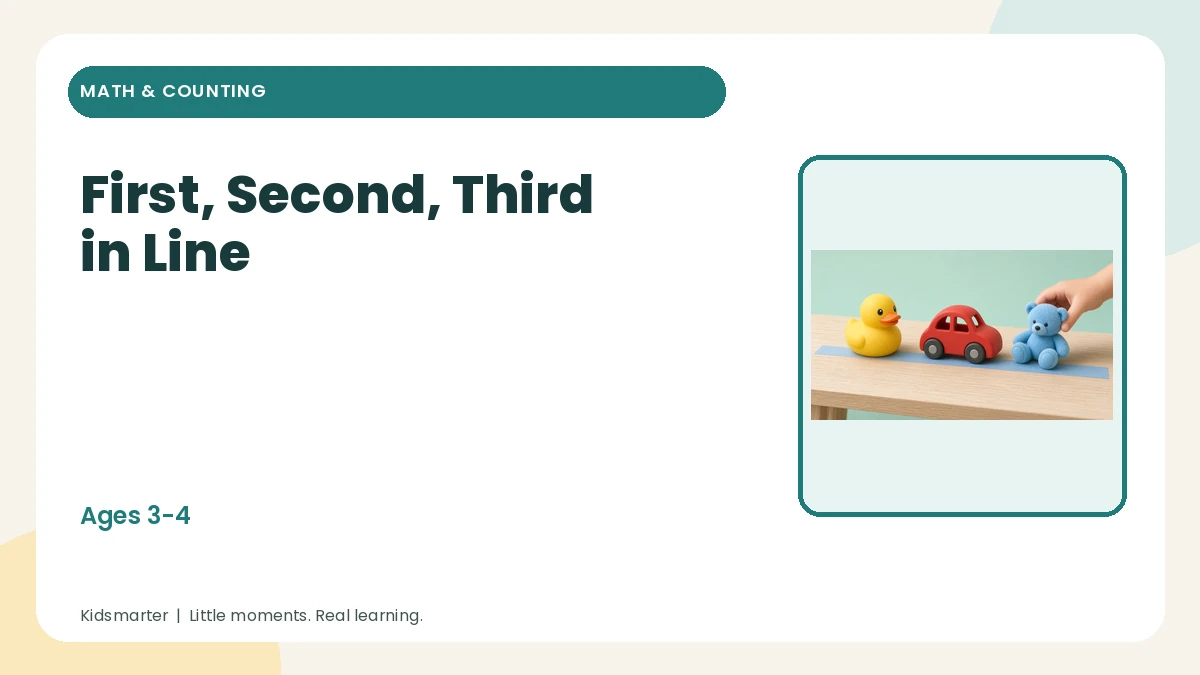
- Three familiar toys that are too large to fit in a child’s mouth and look clearly different from one another, such as a duck, a car, and a stuffed animal
- A strip of painter’s tape, washi tape, or a yarn line on a table or a clear stretch of floor
Sit or kneel on the same side of the line as your child so you share one viewpoint. “First” depends on where you stand; if you face opposite directions, the two ends swap. Keep the line on a table or a rug, not on stairs or in a hallway people need to walk through.
Step-by-Step How to Play
-
Make a short line with the tape. Place two toys on it, leaving space at one end. Say, “We will put them in a line and talk about who is first, second, and third.”
-
Point to the toy at the starting end, from your shared viewpoint, and say, “This duck is first.” Point to the next one: “This car is second.” Invite your child to place the third toy at the remaining end: “The bear can be third.”
-
Look down the line together and repeat the three words slowly. Your child may listen, point, or say a word with you. They do not have to produce all three words on the first try, and this is not a quiz.
-
Rearrange. Move the bear to the front and narrate the new order: “Now the bear is first. The duck is second. The car is third.” A new order is useful information, not a trick question.
-
Play one more round if your child still wants a turn, or stop. Put the toys away together. There is no race, no score, and no required number of rearrangements.
Small Details That Make This Activity Work
Keep the language tied to the toys you can both see. If your child lines the toys up in a different way, describe their line instead of resetting it at once. Avoid “Who is the winner?” or a racing start; those turn order into a contest. This is not a hallway number line, not hopscotch, and not a story-sequence or getting-dressed card game: the words first, second, and third refer to places in this visible line.
Why This Activity Helps
Everyday talk can make order visible. NAEYC’s family math-talk guidance includes number and operations ideas such as quantity and order, and it offers examples of adult language such as “That’s the third time I’ve heard you say mama.” That page is about conversation in daily life, not a test of this three-toy lineup. Completing the lineup is not evidence of school readiness, and children may understand the places in the moment without being able to explain the words first, second, and third on their own.
Easy Ways to Adapt by Age
Make It Simpler
Use only two toys and the words first and second. You can place both toys yourself and simply point: “The duck is first. The car is second.” No rearrangement is required.
Ready for a Challenge
After one line, invite your child to decide a new order and tell you who is first before you move the toys, then check together. You may also add a fourth toy and the word fourth if they are still interested. Stop if the extra word makes the game feel like a test.
Parent Tip & Safety Note
Use three large toys and supervise the whole time so pieces are not mouthed, thrown, or left where a baby can reach them. Keep the line off stairs, balconies, and busy walkways. Do not ask children to stand in a tight line on a step or near a door that may open. If a toy has loose eyes, buttons, or other small parts, choose a different toy. Stop if your child is finished or would rather play with the toys in another way.
Explore more activities in this category or free printable games.
For everyday language about number, quantity, and order, see NAEYC’s Math Talk With Infants and Toddlers and Support Math Readiness Through Math Talk. Those pages offer family conversation examples, including talk about order; they do not test this three-toy lineup, and they do not treat it as a formal ordinal-number curriculum.