Simple Maze Pack: Help Them Get Home
Quick Activity Snapshot
- Age Range: Ages 4–5
- Prep Time: 2 minutes to print
- Skills: Visual planning
- Materials: Printed mazes, A pencil
Age ranges are suggestions, not developmental milestones or standards. Choose the setup for this child, and stop whenever needed.
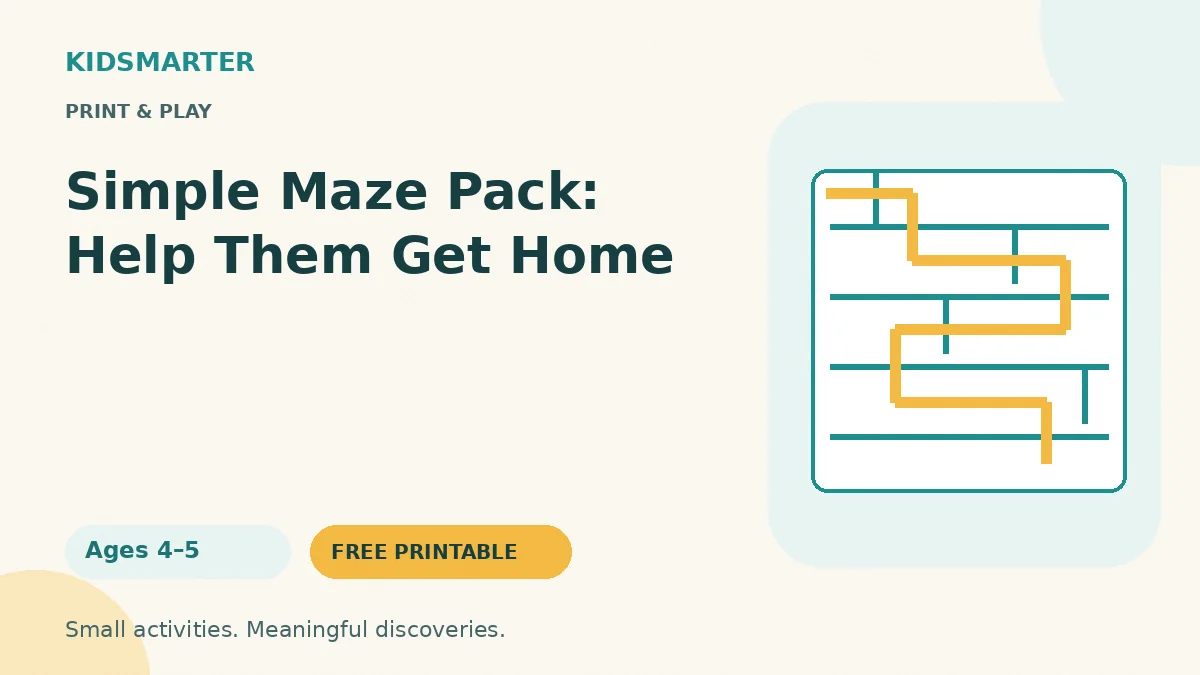
A small maze pack can offer a satisfying quiet activity without turning into a race against the clock. These three printable routes grow gradually more complex: first a short broad path, then more junctions, then a longer search. Your child can stop after any page. Begin with a finger so planning does not depend on pencil control, and treat dead ends as information about the route. The aim is to help the character get home while keeping the experience approachable.
Materials You’ll Need
- Printed mazes
- A pencil
Print the three Letter-size mazes and keep the separate adult solution pages nearby but out of the child's workspace. Add a chunky crayon or pencil and a sheet of scrap paper for covering unused areas. Each maze labels START and HOME, with a little house at the destination. Use actual-size printing when possible so corridors remain comfortable for a finger, though a larger print is also fine.
Step-by-Step How to Play
-
Start with the easiest page even if your child is older. Point to START and HOME, then explain, "We travel through the white paths without crossing a dark wall." Demonstrate a tiny move near the entrance and return to START. Ask your child to show the difference between a wall and an open path. This checks the rule without asking them to solve the maze immediately.
-
Invite a finger journey along the first corridor. Say, "Let's look just a little ahead before we turn." Let the child choose at the first junction and follow that branch to see where it leads. Keep your hands off their finger. If the path closes, show how to move backward along the same corridor until reaching a place with another option.
-
Offer a crayon only after the child understands how to explore the spaces. They may draw the route on the same copy or use a clean copy for a second pass. If the line crosses a wall accidentally, ask whether it was a planned shortcut or a slipping crayon. Separate understanding the route from controlling the tool; a child can solve the planning task with a finger alone.
-
On reaching HOME, ask your child to describe one useful choice: "Where did you turn away from a dead end?" Then offer the next level as an option, not an obligation. The second and third pages have more decisions, so take a break between them if needed. Keep the solved page visible as a reminder that checking and backtracking already worked once.
-
End by letting the child guide your finger through a favorite route using words, gestures, or both. Deliberately pause at a junction so they can explain what comes next. Store unused pages for another day and save the solution sheets for adults. Replaying a known maze is allowed; familiarity can free attention for spatial language and more controlled drawing rather than making the activity worthless.
Why This Activity Helps
Mazes provide small opportunities to scan ahead, compare routes, and revise a choice when evidence changes. Words such as beside, above, turn, and back describe spatial relationships in context. Drawing adds a separate motor demand, which can be removed by pointing. A harder maze is not automatically a better learning activity; the most useful level is one where the child can make meaningful choices without constant adult direction.
Easy Ways to Adapt by Age
Make It Easier: Cover everything except the next short section with scrap paper. Start with only the easiest page and use a finger or large pointer instead of a pencil. An adult can narrate the first choice, then let the child decide the next one. If printed walls are confusing, build a broad route from blocks on the table before returning to paper.
Add a Challenge: Ask an older preschooler to predict two turns ahead, then check the prediction while moving. Invite them to explain the route to someone who has not seen the solution. After completing a page, design a new maze together and test whether an uninterrupted path exists. Avoid blindfolds, speed contests, or punishments for touching lines; they change the task without improving the planning conversation.
Free Printable Included
Print all six pages at actual size. Use the whole maze and solution pages; no cutting is required. Keep the three adult solution pages out of the child’s workspace.
Parent Tip & Safety Note
Adults trim paper if necessary and supervise children under three around pencils, caps, small counters, and scraps. Keep tools blunt and the page stable at a comfortable viewing distance. Do not leave young children with tiny maze tokens; fingers work well. Stop when the child tires or becomes upset, and keep completed sheets private rather than comparing one child's performance with another online.