Lid Size Line-Up
Quick Activity Snapshot
- Age Range: Ages 2–3
- Prep Time: 5 minutes
- Skills: Size comparison
- Materials: Three large intact plastic food-container lids, each broader than an adult palm and without removable seals
Age ranges are suggestions, not developmental milestones or standards. Choose the setup for this child, and stop whenever needed.
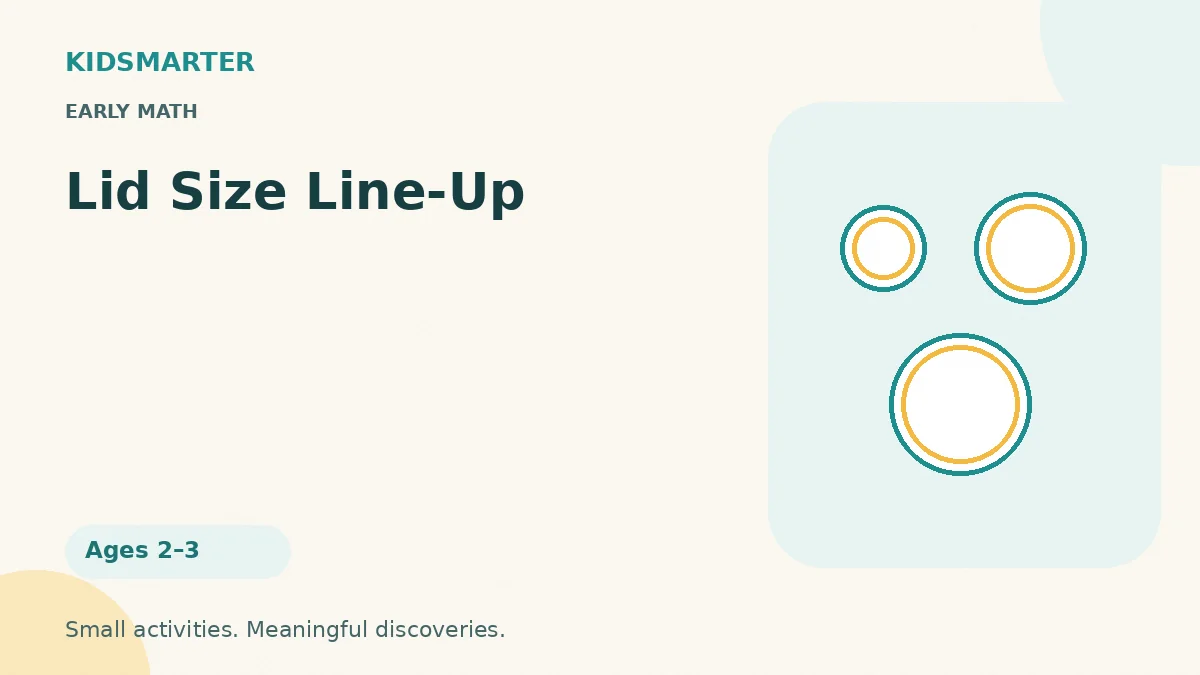
Container lids are surprisingly good conversation starters: one is enormous, another almost hides beneath it, and a third seems to belong in the middle. This game turns those observations into a short ordering challenge. Begin with three broad plastic lids that differ clearly in size and share a similar shape. Your child can compare them directly instead of guessing from across the table. There is no stopwatch, and a partly finished line is still worth discussing.
Materials You’ll Need
- Three large intact plastic food-container lids, each broader than an adult palm and without removable seals
Collect three clean food-container lids of the same general shape, without cracks, sharp rims, loose seals, or valves. Round lids make diameter, rather than thickness or handle size, the comparison. Exclude bottle caps and lids from chemical containers. “Broader than an adult palm” is a selection cue, not a safety test. If the child bites or mouths lids, leave them put away: an adult can draw three circles on one intact sheet and invite pointing to the largest, then redraw them in size order. This version needs no loose pieces.
Step-by-Step How to Play
-
Put down the smallest and largest lids first. Let your child handle them and place one on top of the other. Say, "This one fits inside that outline. It is smaller." Compare across the flat face rather than height or thickness. Using two lids that are obviously different makes the initial meaning of smaller and bigger easier to see.
-
Place those lids far apart on the mat and introduce the third. Ask, "Where could this one go?" Demonstrate comparing it with the large lid, then with the small one. Say, "It is smaller than this, but bigger than that." Give the child time to move it between the two ends. Avoid using "medium" as the only explanation for the relationship.
-
Slide the three lids into a row from smallest to largest. Run a finger beneath the row and describe the change: "Small, bigger, biggest." Then mix the pieces gently and invite your child to rebuild the line. If the order changes, compare a neighboring pair directly by overlapping their edges, rather than asking the child to defend a choice they cannot yet explain.
-
Add a fourth lid only when three feel manageable. Ask your child to find a space for it without starting the whole line again. Move the neighbors apart so there is a physical gap to fill. Narrate the check: "This new one covers that lid, but it does not cover the next one." Direct comparison is more useful than demanding a quick visual answer.
-
Finish with an optional fitting job only if matching clean tubs are available. Let your child rest a lid loosely on a tub to compare the outlines; an adult handles any firm snap-on closure so fingers are not caught at the rim. Explain that the biggest lid is not automatically the right one. Repeat the same three-lid set another day before adding nearly identical sizes.
Why This Activity Helps
Ordering objects by a measurable attribute is often called seriation. Here the attribute is the width of similar flat lids, which children can compare through overlap. A lid can be bigger than one neighbor and smaller than another, introducing relational language rather than fixed labels. This experience can support later comparison and measurement ideas, but it does not require knowing centimeters, reading numerals, or producing a perfect six-item sequence.
Easy Ways to Adapt by Age
Make It Easier: Stay with two dramatically different lids and ask the child to hand you the bigger one. Let them stack the smaller on the larger to check. Use a mat with two drawn circles as parking spaces if an open-ended line feels unclear. One or two comparisons are enough for a toddler who would rather stack than arrange.
Add a Challenge: Offer five lids with closer differences and invite an older preschooler to reverse the order. Remove one from the middle and ask where it belongs when returned. Later, compare a round lid with a square one and discuss why "bigger" becomes less obvious when one object is wider but the other is longer.
Parent Tip & Safety Note
Supervise children under three directly and exclude bottle caps, detachable gaskets, or any small pieces they could swallow. Wash lids before play and inspect the rims. Do not use lids from chemical containers, even if rinsed. Keep the comparison language neutral: a lid that is larger is not better, and a child who experiments with stacking is not doing the activity badly.