Double the Snack Set
Quick Activity Snapshot
- Age Range
- Ages 5–6
- Prep Time
- 5 minutes
- Skills Built
- Doubling and early addition
- Materials
- The revised doubles worksheet, A whole crayon and fresh worksheet copies, Optional ten matching intact age-appropriate blocks, only if suitable
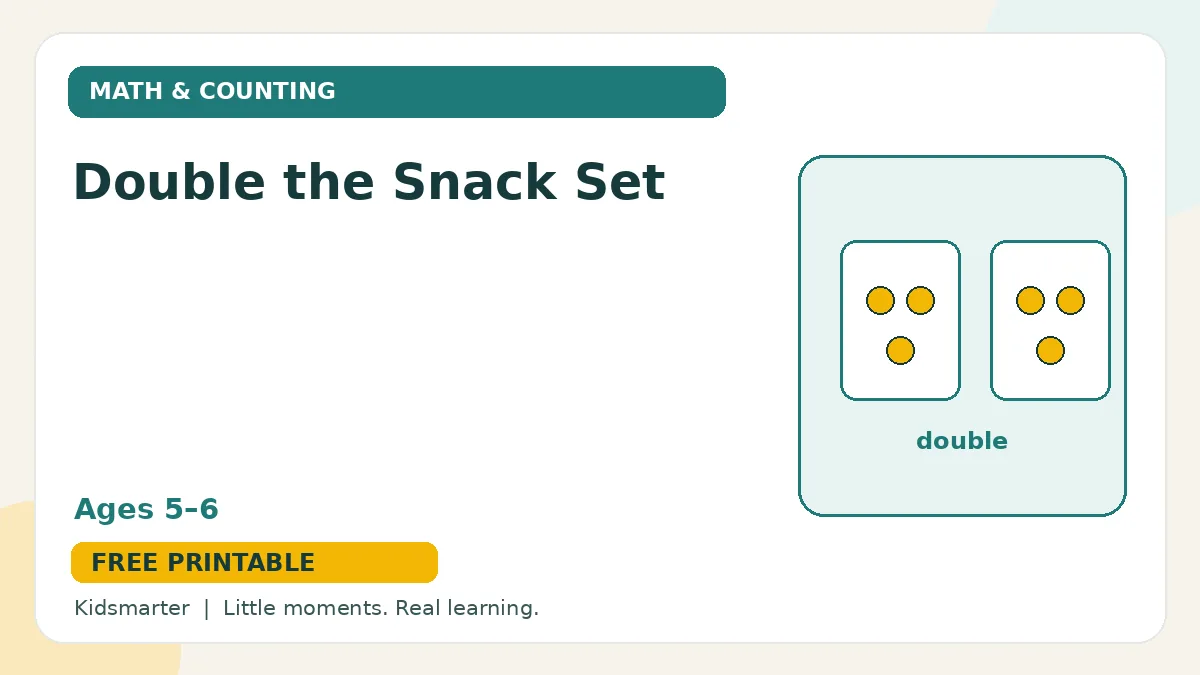
A double is two groups with the same number. In this version of Double the Snack Set, use drawn marks rather than food: three marks in one group and three in another make six altogether. The familiar “one set, the same again” idea works without eating, drilling facts, or finishing a snack to complete a turn.
Materials You’ll Need
- The revised doubles worksheet
- A whole crayon and fresh worksheet copies
- Optional ten matching intact age-appropriate blocks, only if suitable
Use the revised whole-page worksheet. The first set and matching set each have five boxes; the “All together” frame has ten. Start with two marks, then try three or four. A physical variation needs ten matching suitable objects to reach five and five, but drawn marks avoid loose pieces. Keep snacks for an ordinary separate eating time, with the counting sheet put away.
Step-by-Step How to Play
-
Draw two marks in the first set and count them: “One, two. Two marks.” Ask, “Can we make the same amount again?” Draw two in the next row, with one mark for each partner above. The empty boxes are spaces, not extra objects to count.
-
Point from each first-row mark to one second-row mark. Each should have a partner. If you drew too many, use a fresh worksheet for a clear example rather than counting crossed-out marks as part of the group. With suitable blocks, pair one from each group without changing how many are in either group.
-
Count the first two marks and the matching two: four altogether. Record four in the total space. The bottom ten-frame is a new drawing of that same total, not a third group to add. If using suitable blocks, combine the original four BESIDE the sheet rather than requiring blocks to fit the boxes; an adult may draw the record.
-
Use a fresh copy for three and three, which makes six, or four and four, which makes eight. Say the total aloud; writing a numeral is optional. Stop after one example if that is enough. Unused boxes are simply left empty.
-
Let your child choose a starting amount from one to five, then help make its matching group. Point to the two equal groups before counting the combined total. Put the worksheet and any optional objects away when finished. No snack has to be earned, doubled, or eaten to finish this game.
Small Details That Make This Activity Work
A matching group has the same number even if the spaces between its marks look different. Check by pointing to partners rather than requiring a copied picture. If you draw three in a line and three in a little cluster, there are still three in each group. Keep one double per sheet so earlier examples are not accidentally included in the next total.
Why This Activity Helps
A double shows one amount and the same amount again. Matching the two groups checks that they are equal; counting both gives the combined total. The bottom frame records that total in a new arrangement. Point back to the original rows when discussing it so the extra drawing is not mistaken for extra objects in the story.
Easy Ways to Adapt by Age
Make It Simpler
Stay with two and two. An adult can draw while the child points to where each matching mark should go. Accept pointing to the two equal groups without a spoken total, and leave number writing optional.
Ready for a Challenge
On a fresh sheet, try five marks and a matching five. Count ten altogether and record that same ten in the bottom frame. A prediction is optional; pairing and recounting are ways to check. There is no need to write an equation or finish a page of doubles in one sitting.
Parent Tip & Safety Note
Use the whole-sheet drawing version whenever loose objects are unsuitable. Do not use bottle caps, coins, beans, or small food pieces as counters. Keep broken crayons and optional block parts out of reach of younger children. If a meal follows, clear the game first so eating can be calm and separate from questions.
The age range above is a suggested starting point, not a milestone or a standard. Use a small amount your child wants to compare, and let an adult do the drawing or writing whenever useful.
Find another small invitation to play in Math & Counting, or explore our free printable games. Choose one that fits your child’s interests, available materials, and energy today.