Cover Clues: A Three-Question Book Walk
Quick Activity Snapshot
- Age Range
- Ages 3–4
- Prep Time
- 2 minutes
- Skills Practiced
- Shared reading and prediction
- Materials
- One picture book
Age ranges are suggestions, not developmental milestones or standards. Choose the setup for this child, and stop whenever needed.
Before you read the first page, a book cover offers a small mystery to investigate together. This three-question walk gives your child a reason to look closely and make a guess, while leaving plenty of time for the story itself. No answer sheet is needed.
Materials You’ll Need
- One picture book
Choose a picture book your child wants to explore and sit where both of you can see it. Keep the cover visible. The questions are invitations, not a test of whether your child can predict an author's plot.
Step-by-Step How to Play
-
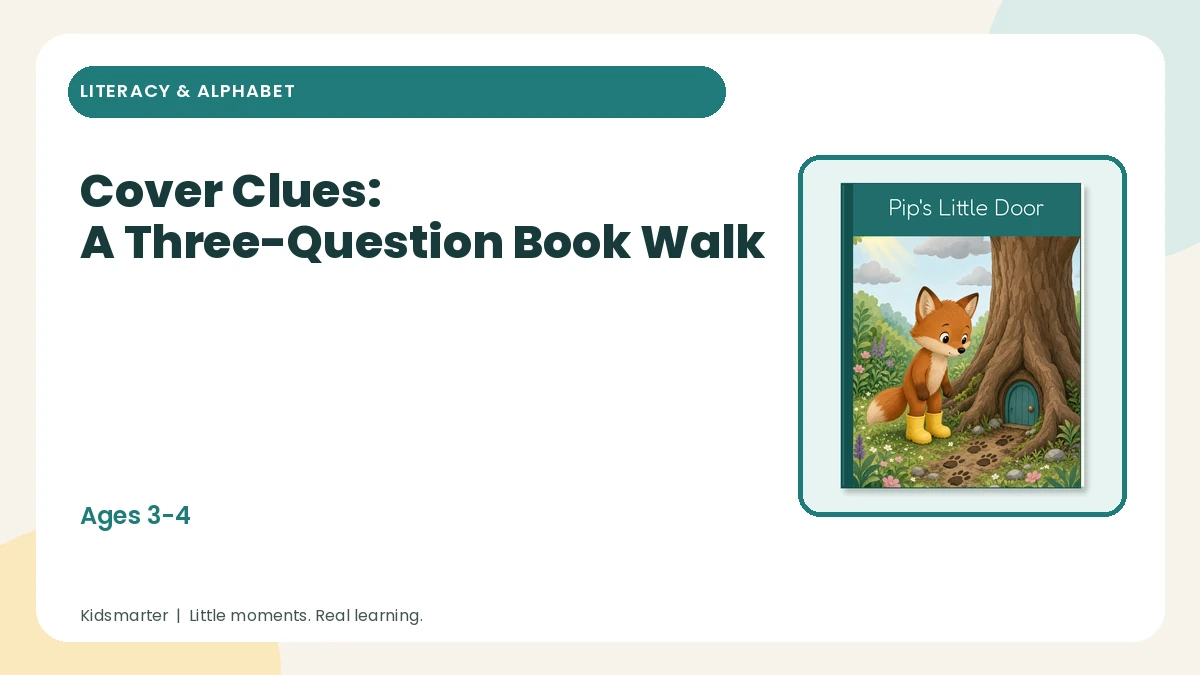
Ask, “What do you notice?” Point to one detail yourself if needed: muddy boots, a tiny door, or an animal's expression. Wait for a gesture or a few words without immediately adding another question.
-
Ask, “What do you think might happen?” Connect a guess to something visible. Say, “You think they might get wet because you noticed those clouds.” Accept imaginative guesses without labeling them correct or incorrect.
-
Ask, “What would you like to find out?” Offer your own wondering if the question feels abstract. “I wonder who lives behind that door.” Turn a child's statement into a wondering only with their agreement.
-
Read the book normally, pausing where your child wants to comment. Do not stop at every page to check the original prediction. Enjoying the narrative matters more than remembering the three questions.
-
After the ending, return briefly to the cover. Ask whether one detail makes new sense now. It is fine to say, “Our guess was different from the story,” and leave the conversation there.
Small Details That Make This Activity Work
The three questions need not be asked in rapid succession. Spend most of the time on whichever invitation produces a real conversation, and skip the rest if the story is calling. When a child says “I do not know,” offer your own observation rather than rephrasing the question repeatedly. In a familiar book, wondering can shift from predicting the plot to noticing an illustrator’s choice. Some covers suggest a mood rather than a scene that appears inside; say, “That is what the cover made us imagine,” instead of promising that the event will happen. If a child points rather than speaks, describe that detail and begin reading.
Why This Activity Helps
These invitations give you and your child a way to discuss what is visible and what is still uncertain. Linking a guess to a picture makes the child’s reasoning available for conversation; it does not prove that the guess will match the plot. This particular three-question routine has not been evaluated as a reading intervention, and completing it is not evidence of reading readiness.
Easy Ways to Adapt by Age
Make It Simpler
Use just “What do you see?” and name pictures together. For a child with fewer spoken words, offer two things to point to, then follow whichever picture attracts attention.
Ready for a Challenge
Compare the cover with the final illustration. Ask what the illustrator kept the same and what changed. Let your child invent a different title and explain the choice.
Parent Tip & Safety Note
Choose comfortable seating and durable books when younger siblings join. Let your child decline questions and hear the story uninterrupted. Reading together should remain a relationship, not a performance with compulsory answers.
Explore more activities in this category or free printable games.
For examples of responsive book talk, see NAEYC’s questions that invite conversation. Follow the child’s response rather than completing a question quota.