A Group of Three
Quick Activity Snapshot
- Age Range
- Ages 3–4
- Prep Time
- 2 minutes
- Skills Practiced
- Making a set of exactly three objects and counting them
- Materials
- A cloth and a few large, unbreakable objects
Age ranges are suggestions, not developmental milestones or standards. Choose the setup for this child, and stop whenever needed.
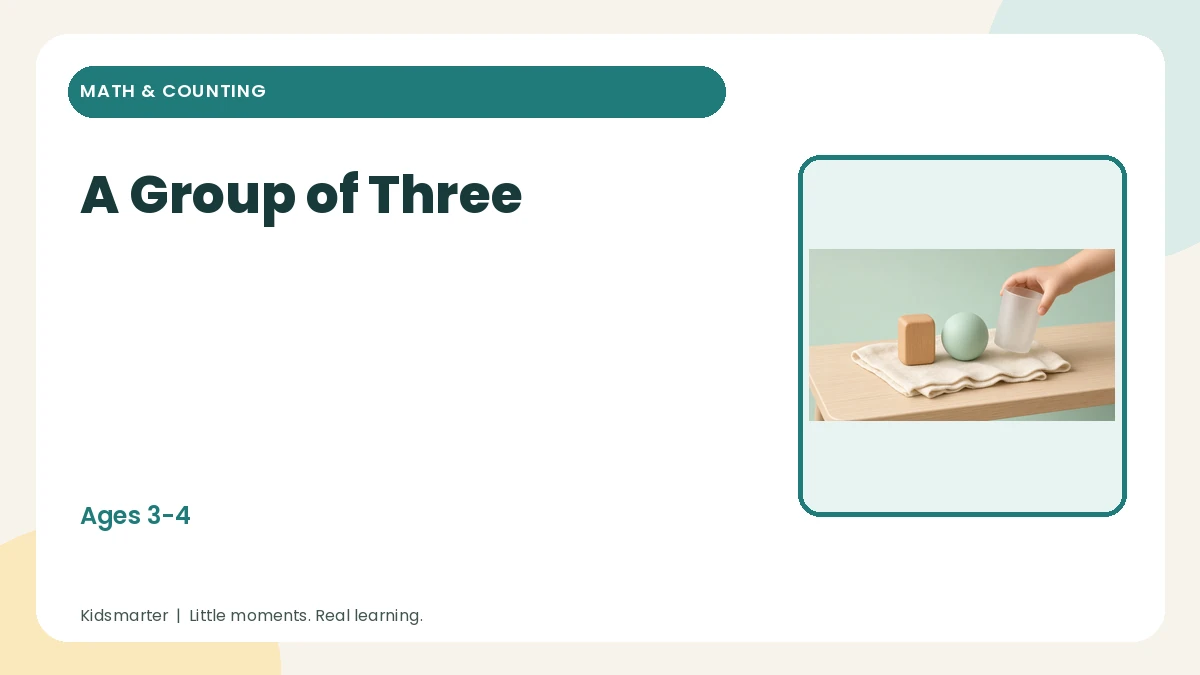
A small set can have a clear number. You and your child gather exactly three large objects on a cloth, then count them together. This is not adding one more to a tray, not packing a box to see how many fit, and not lining objects up to name first, second, and third.
Materials You’ll Need
- A folded cloth or a clear space on a table
- Four or five large, unbreakable objects, such as a wooden block, a large ball, and a sturdy plastic cup, each too big to swallow
You do not need number cards. Use only large objects. Do not use buttons, beads, coins, or other small treasures that could be a choking hazard.
Step-by-Step How to Play
-
Set the cloth on the table and place a small pile of large objects beside it. Say, “Let’s make a group of three on the cloth.”
-
Invite your child to choose objects and put them on the cloth. If they place two, you can say, “We have two. We need one more to make three.” If they place four, take one back together and count again.
-
When three objects are on the cloth, point to each one and count slowly: “One, two, three. Three things in our group.”
-
If they still want a turn, you may clear the cloth and make a new group of three with different objects from the same pile. Stop after one or two groups. There is no required number of rounds.
Small Details That Make This Activity Work
Keep the objects large and easy to see, and count by pointing to each one when the group is ready. The objects do not have to match; a block, a ball, and a cup can still be a group of three. If they want to play with only one favorite object, you can count that one and stop. This is not a one-more tray game, not a packing-the-box count, not first-second-third in a line, and not matching two pictures that show the same number: the job is to make one set that has three.
Why This Activity Helps
Making a set of three and counting it is one everyday way to talk about quantity. NAEYC’s family page Preschoolers Are Natural Mathematicians includes math talk such as choosing three books from a shelf. That page offers family examples; it does not evaluate this cloth-and-three-objects game, and making a group of three is not evidence of later math achievement. The same page also mentions small items such as buttons and beads, which we do not use here. Children may enjoy placing the objects without counting the set aloud.
Easy Ways to Adapt by Age
Make It Simpler
Place two objects on the cloth yourself, then invite your child to add the third. Count “one, two, three” together.
Ready for a Challenge
After one group of three is easy, ask, “Can we make another group of three?” using the leftover objects. Stop if the extra hunt starts to feel like a quiz.
Parent Tip & Safety Note
Stay at the table. Use only large, unbreakable objects that are too big to swallow. Do not use buttons, beads, coins, or food that could be a choking hazard. Put extra objects out of reach once the group is made, and put everything away when you finish. Stop when your child is finished or wants to play with the objects in another way.
Explore more activities in this category or free printable games.
For family math talk about a quantity of three, such as choosing three books from a shelf, see NAEYC’s Preschoolers Are Natural Mathematicians. That page offers everyday examples; it does not test this cloth-and-three-objects game, and it does not treat making a group of three as a developmental screening. The small treasures mentioned on that page are not used in this activity.