Big or Small?
Quick Activity Snapshot
- Age Range
- Ages 2–3
- Prep Time
- 2 minutes
- Skills Practiced
- Noticing which of two objects is big and which is small
- Materials
- Two unbreakable objects with a very clear size difference, and a low table
Age ranges are suggestions, not developmental milestones or standards. Choose the setup for this child, and stop whenever needed.
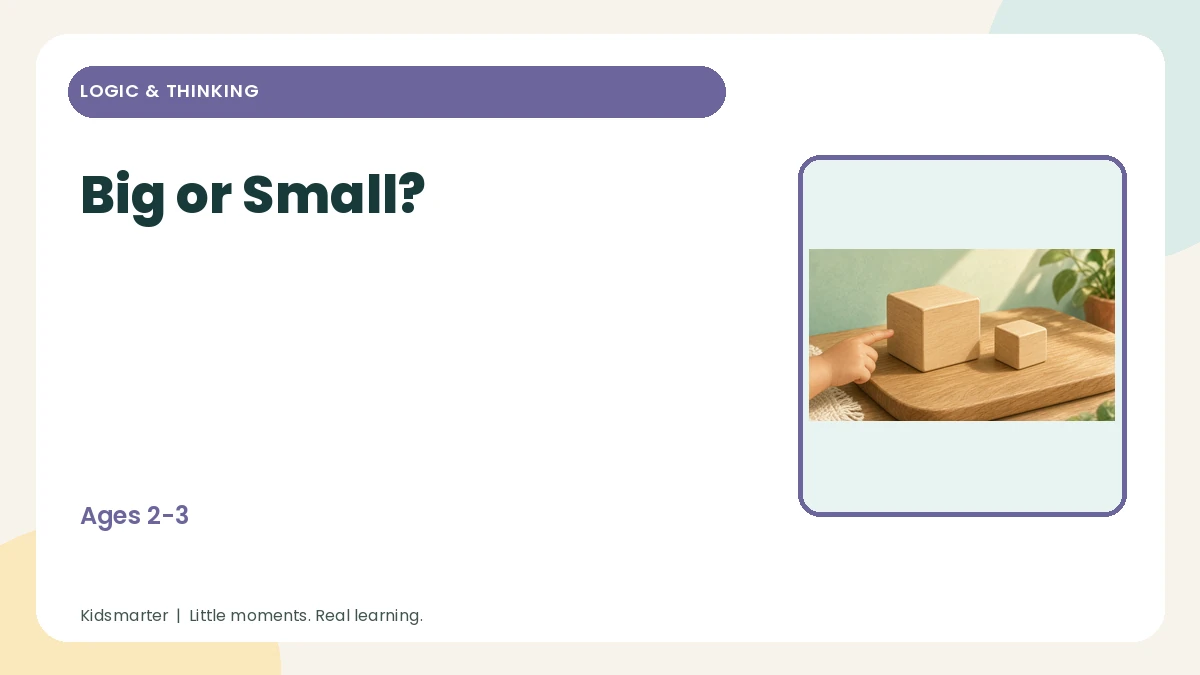
Two familiar objects can sit side by side in an easy-to-see way: one is big, and one is small. You name the two sizes, and your child helps point to which is which. This is not measuring with a string, not asking whether something is taller than a block, and not comparing which cup holds more.
Materials You’ll Need
- Two unbreakable objects with a very obvious size difference, such as a large wooden block and a clearly smaller wooden block, each still too big to swallow
- A low, stable table, or a clear patch of floor, where both objects can sit side by side
Stay with your child. Use only unbreakable objects, never glass, and never tiny pieces. The smaller object must still be too big to swallow. Keep both objects on the same surface so this is not a floor-or-table game, and do not climb or stand on a chair to compare them.
Step-by-Step How to Play
-
Set the two objects side by side. Say, “One is big, and one is small.”
-
Point to the large object and say, “This one is big.” Point to the smaller object and say, “This one is small.”
-
Invite your child to point to the big one, or to the small one. If they touch the other one first, you can name its size and try again. There is no score.
-
If they still want a turn, you may switch the places of the two objects and name the sizes again. One or two clear comparisons can be a complete game.
Small Details That Make This Activity Work
Keep both objects on the same table or the same patch of floor, with a clear gap so the size difference is easy to see. Do not add a string, a third object to measure against, or a cup of water this time. If they only want to hold the big block, you can name “big” and stop. This is not “is it longer than this string,” not “is it taller than this block,” not “which cup holds more,” not a homemade balance for heavier or lighter, not a lid-size line-up, and not a cut-and-paste size sort: the job is noticing which object is big and which is small.
Why This Activity Helps
A short, visible comparison gives a reason to use the words “big” and “small.” There is no official study cited for this homemade table game, and deciding which object is big is not evidence of later skill. Children may enjoy holding the blocks without naming the sizes.
Easy Ways to Adapt by Age
Make It Simpler
Do the pointing yourself: “Big. Small.” Then invite your child to touch only the big object.
Ready for a Challenge
After one round, switch the places and ask, “Which one is small now?” Stop if it starts to feel like a quiz.
Parent Tip & Safety Note
Stay at the table. Use only unbreakable objects; never glass, and never tiny pieces that can fit in a mouth. Both objects, including the smaller one, must be too big to swallow. Keep objects away from the table edge so they cannot fall and hit anyone, and do not let the child climb onto the table or stand on a chair to compare them. Stop when your child is finished or wants to play with the objects in another way.
Explore more activities in this category or free printable games.