Near or Far?
Quick Activity Snapshot
- Age Range
- Ages 2–3
- Prep Time
- 2 minutes
- Skills Practiced
- Noticing which object is near and which is farther away
- Materials
- Two large toys on the same table
Age ranges are suggestions, not developmental milestones or standards. Choose the setup for this child, and stop whenever needed.
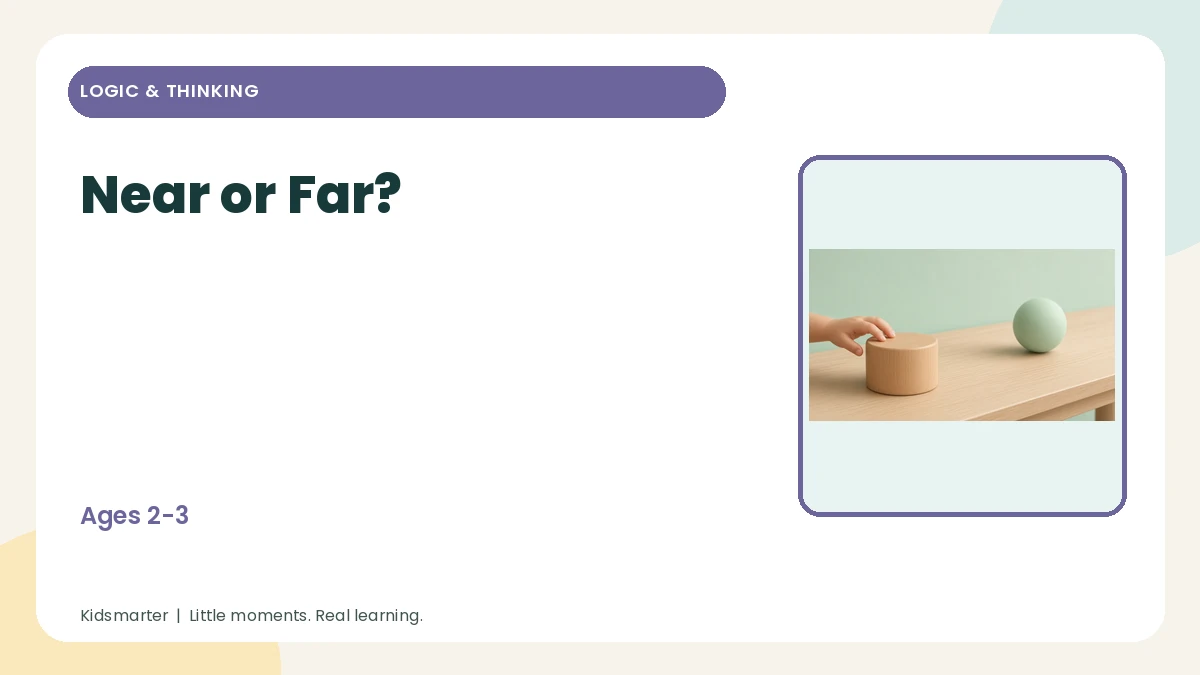
Two toys on a table can sit at different distances. You place one close to your child and one farther down the same table, then you talk about which is near and which is far. This is not a left-or-right treasure hunt, not an in-on-under game, and not a two-step job of fetching something from another room.
Materials You’ll Need
- Two large, unbreakable objects, such as a wooden block and a large ball, each too big to swallow
- A table long enough to place one object close and one farther away, still fully on the tabletop
Keep both objects on the same table, within easy reach of an adult. Do not send the child running across a room or near stairs to find the far object.
Step-by-Step How to Play
-
Sit together at the table. Place one object close to your child and the other farther down the table. Say, “One is near, and one is far.”
-
Point to the close object and say, “This one is near.” Point to the farther object and say, “That one is far.”
-
Invite your child to touch the near object, then the far one, or to tell you which is near. If they touch the other one first, you can name it and try again. There is no score.
-
If they still want a turn, you may switch which object is near and which is far. One or two rounds are enough.
Small Details That Make This Activity Work
Keep both objects in view on the same table, with a clear gap so near and far are easy to see. The far object should still be close enough that you can reach it without leaving your child’s side. If they want only to play with the near toy, you can name it as near and stop. This is not a left-and-right hunt around the living room, not in-on-and-under position cards, not a kitchen-or-bedroom sort, and not a two-step fetching job: the job is noticing near and far on the table in front of you.
Why This Activity Helps
A short, visible comparison gives a reason to use the words near and far. There is no official study cited for this homemade table game, and deciding which toy is farther is not evidence of later skill. Children may enjoy touching the toys without naming the words.
Easy Ways to Adapt by Age
Make It Simpler
Use a very clear gap, and do the pointing yourself: “Near. Far.” Then invite your child to touch only the near object.
Ready for a Challenge
After one round, switch the places and ask, “Which one is near now?” Stop if it starts to feel like a quiz.
Parent Tip & Safety Note
Stay at the table. Use only large, unbreakable objects. Keep the far object on the table, not on the floor across the room, and not near stairs, a stove, or a table edge where it could fall. Do not make the game a race. Put the objects away when you finish. Stop when your child is finished or wants to play with the toys in another way.
Explore more activities in this category or free printable games.