One More on the Tray
Quick Activity Snapshot
- Age Range
- Ages 3–4
- Prep Time
- 2 minutes
- Skills Practiced
- Counting a small set, then counting again after one more is added
- Materials
- A sturdy tray and a few large blocks
Age ranges are suggestions, not developmental milestones or standards. Choose the setup for this child, and stop whenever needed.
A small set on a tray can change by one. You count what is there, add one more object, and count the new total together. This is not taking a snack away, not packing a box to see how many fit, and not matching two pictures that show the same number.
Materials You’ll Need
- A sturdy, shallow tray that sits safely on a table
- Three to five large, unbreakable objects, such as wooden blocks, each too big to swallow
You do not need number cards or a written plus sign. Keep the objects large, and do not use glass, beads, or food that could be a choking hazard.
Step-by-Step How to Play
-
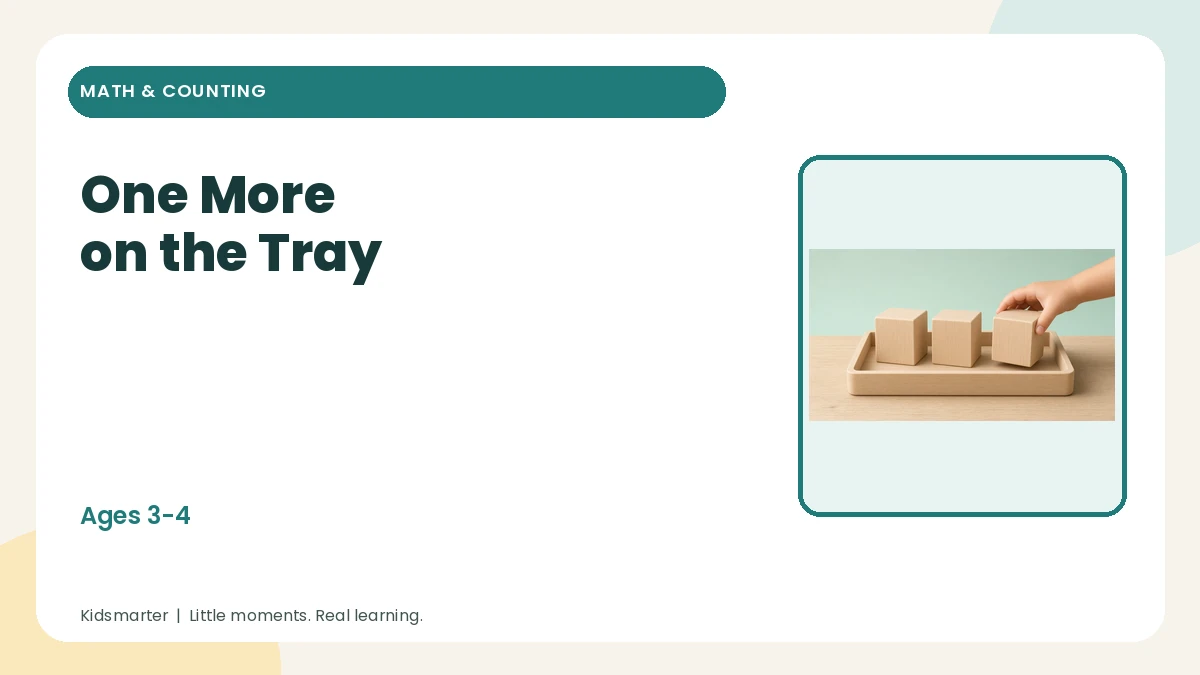
Place two large blocks on the tray. Point to each one and count slowly: “One, two. Two blocks on the tray.”
-
Hold up one more block and say, “Here is one more.” Place it on the tray.
-
Count the blocks again, pointing to each one: “One, two, three. Three blocks now.”
-
If they still want a turn, they may place the next “one more,” and you count the new total together. Stop at four or five. There is no required number to reach.
Small Details That Make This Activity Work
Start with two so the change is easy to see. Count by pointing to each object after you add one. If they want to stack the blocks or take one off, you can count what is left and stop; this game is about adding one, not about building a tower. This is not a take-away snack count, not a packing-the-box game, not same-number picture matching, and not a dice addition mat.
Why This Activity Helps
Adding one object and counting again is one everyday way to talk about how a set can change. NAEYC’s family math-talk guidance includes number, quantity, and one-to-one counting, and it includes operations language in daily talk. Those examples are about everyday language, not a test of this tray game, and adding one object is not evidence of later math achievement. Children may enjoy placing the block without counting the new total aloud.
Easy Ways to Adapt by Age
Make It Simpler
Start with one block, add one more, and count “one, two” together. You may do all the placing.
Ready for a Challenge
After three, ask, “If we put one more on the tray, how many will we have?” Then add the block and count to check. Stop if the extra prediction starts to feel like a quiz.
Parent Tip & Safety Note
Stay at the table. Use only large, unbreakable objects. Do not use the tray to carry hot things or glass. Put extra blocks out of reach so the set stays small. Stop when your child is finished or wants to play with the blocks in another way.
Explore more activities in this category or free printable games.
For everyday language about number, quantity, one-to-one counting, and operations, see NAEYC’s Math Talk With Infants and Toddlers. That page offers family conversation examples; it does not test this one-more tray game, and it does not treat adding one object as a developmental screening.