Read-It-and-Swap Sentence Strips
Quick Activity Snapshot
- Age Range
- Ages 5–6
- Prep Time
- 10 minutes
- Skills Built
- Early sentence reading
- Materials
- Paper sentence strips, A marker, A few interchangeable word cards (the, cat, sat, mat)
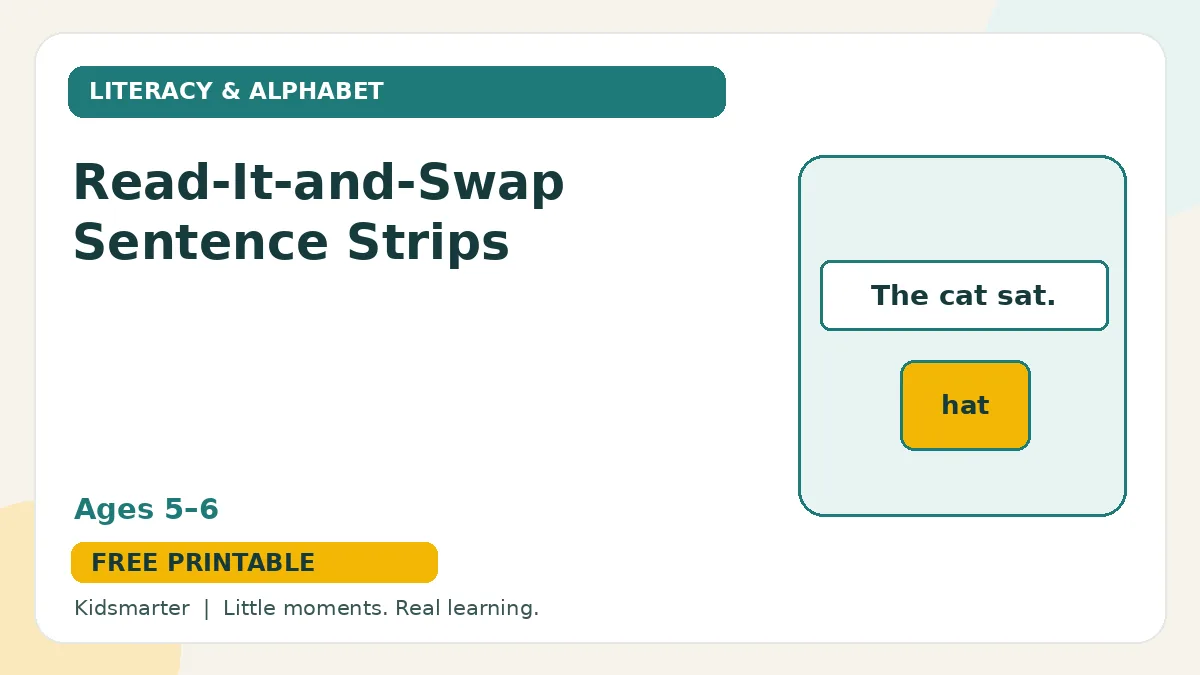
A familiar sentence can become a small reading experiment when one word is replaceable. “The cat sat on the mat” becomes “The cat sat on the bed” using cards that are actually on this printable. Begin only with words the child can already decode, and supply unfamiliar words yourself. The useful comparison is between the printed words and their meanings, not how quickly a memorized sentence can be recited.
Materials You’ll Need
- Paper sentence strips
- A marker
- The six-word model and matching cards, plus dog and bed for the first swaps
Prepare the six-word model “The cat sat on the mat.” The PDF includes dog and bed, but no rug card. For the first two swaps, use cat → dog in word position 2, then restore cat and use mat → bed in position 6. Keep the other printed cards aside. Read The/the and any unfamiliar word yourself; the child need not decode spellings that have not been introduced.
Step-by-Step How to Play
-
Place the original sentence in a straight line with spaces between words. Read it slowly while pointing beneath each word, not each letter. Explain, ‘The spaces show where one word ends and the next starts.’ Point out the capital at the beginning and the period that signals a finished statement.
-
Read the sentence together again, helping your child blend cat, sat, and mat. Supply the pronunciation of the and talk briefly about its unusual spelling for a beginner. Ask your child to act out the sentence with a toy or hands, checking meaning after the print has been read.
-
Cover cat with dog and ask which word changed. Look at all three letters, model /d/ followed by the short o and /g/ as needed, then blend dog. Reread the six-word sentence together. If your child repeats cat from memory, compare the whole new word with the old one rather than using its first letter as a guessing cue. Supply dog if its vowel or other sounds are unfamiliar.
-
Restore cat, then cover mat with the supplied bed card. Model bed if needed and reread “The cat sat on the bed.” Ask what changed in the imagined scene. Change only this noun on the first turn; sat → ran can be a later experiment. Sun and bus are optional extra word cards, not required answers, and a nonsensical sentence is something to discuss rather than a grammar failure.
-
Keep The, on, and the in their positions. Mix the cat, sat, and mat cards and compare with the printed model to rebuild the sentence. Explain that the blank row has six spaces for six words, not six individual letters. An adult can write directly into those spaces instead of using cut cards. Draw the new scene only after reading; it is not a clue for guessing the changed word.
Small Details That Make This Activity Work
Save the drawn scene with the strip and revisit it later. Ask your child to locate the changed word before reading. That habit helps distinguish careful rereading from remembering a chant, and may make them want to return tomorrow.
Why This Activity Helps
Sentence reading combines recognizing or decoding individual words with keeping their meanings together. A controlled substitution holds most of the text steady so attention can focus on one changed word. Pointing and visible spaces encourage one-to-one tracking across print. The drawing or action checks comprehension without asking a long list of questions. If a child ignores the new card and repeats the old sentence, slow down and examine that word together.
Easy Ways to Adapt by Age
Make It Simpler
Read the strip yourself and invite your child to find one familiar word each time. Offer only two replacement choices and help pronounce them. A child not yet blending can use the pictures for oral sentence play without being expected to read.
Ready for a Challenge
Ask your child to dictate a new sentence using familiar words, then help write it with a capital and period. Try changing the subject and discussing whether the sentence still makes sense, but introduce plural grammar separately.
Parent Tip & Safety Note
Keep the strip flat on a table; an adult handles scissors. When pieces are mouthed or younger children share the surface, keep the PDF intact and have the adult write the replacement word on a separate whole sheet or supply it orally while pointing. Do not use tiny letter tiles, magnets, or small word pieces as the safer alternative. Stop rereading when it stops feeling like a story, not after a required number of repetitions.
The age range above is a suggested starting point for this setup, not a developmental milestone or a standard your child must meet. Keep the first session to one model sentence and a few swaps, and stop while the new sentence still feels like a small story.
Find another small invitation to play in Literacy & Alphabet, or explore our free printable games. Choose one that fits your child’s interests, available materials, and energy today.
For general support with left-to-right tracking and unfamiliar words, see Reading Rockets’ phonics and decoding guidance. The selected sentence cards are an original practice set, not a reading assessment.