Which Toy Is Missing?
Quick Activity Snapshot
- Age Range
- Ages 3–4
- Prep Time
- 3 minutes
- Skills Practiced
- Observation and memory
- Materials
- Three intact age-appropriate toys, only if suitable for this child, A low tray or clear tabletop, Whole paper and a crayon for an adult-drawn alternative
Age ranges are suggestions, not developmental milestones or standards. Choose the setup for this child, and stop whenever needed.
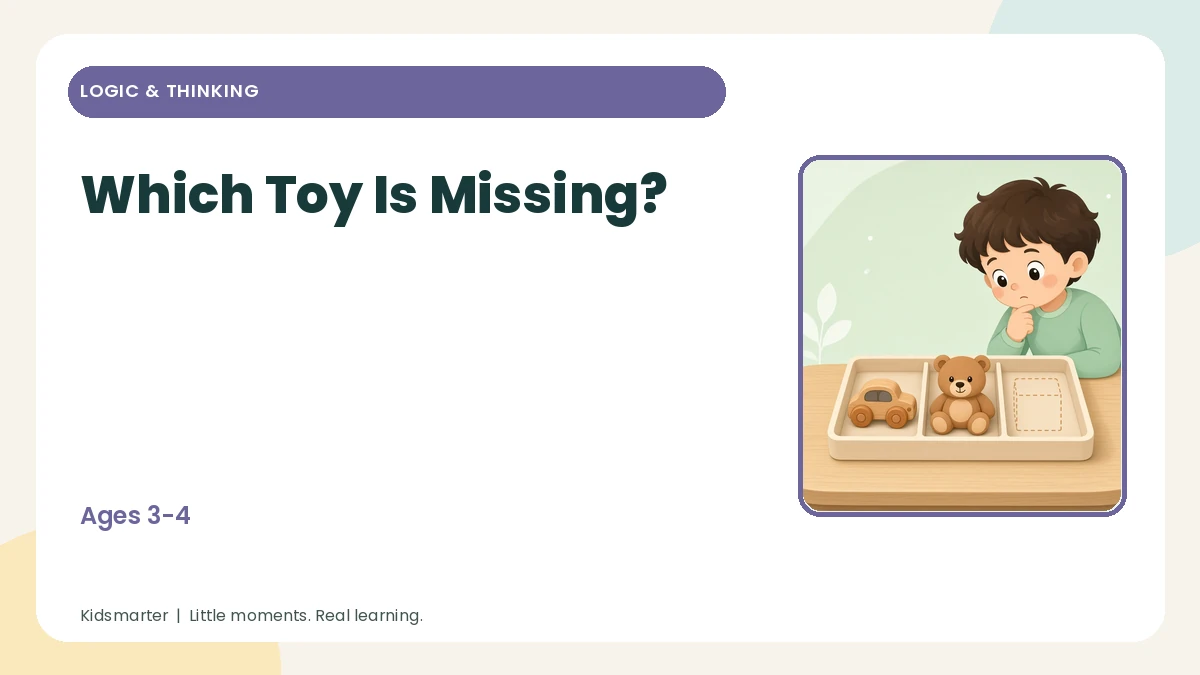
Something has disappeared from the tray, but which thing? A tiny missing-toy game invites close looking and a simple retrieval strategy. Begin with three objects rather than a crowded collection so your child can learn the routine without being overwhelmed by choices.
Materials You’ll Need
- Three intact age-appropriate toys, only if suitable for this child
- A low tray or clear tabletop
- Whole paper and a crayon for an adult-drawn alternative
Choose three familiar toys with clearly different shapes. Check each for damage or detachable parts; leave unsuitable pieces put away. No cloth is needed. If mouthing makes the objects unsuitable, an adult can draw three familiar objects spaced across one whole sheet, then prepare a second drawing with one omitted and its position left empty. Keep the first drawing face down until the check, with all paper managed by the adult.
Step-by-Step How to Play
-
Name each toy together and describe its position: “Car on this side, block in the middle, bear at the end.” Invite your child to touch or point to each object as you review the tray.
-
Invite your child to look toward another part of the clear table while you remove one toy, leaving the other two still. They need not close or cover their eyes. If they prefer to watch, play an open “what went away?” round. For the drawing version, show the three-object sheet, turn it face down, then show the prepared two-object picture.
-
Ask, “Which toy is missing?” Accept pointing toward its former place or describing its color. If no answer comes, name the original three objects slowly, leaving a pause for the absent one.
-
Reveal the missing toy and return it to its original spot. With drawings, place the original sheet beside the changed one and point to the missing picture. Review all three before another turn. Keep the positions stable so a remembered location remains useful.
-
Your child can choose which toy to remove while you look away, if handling the toys is appropriate. Otherwise they can point to the choice and let an adult manage it. Think aloud on your turn: “The bear and car are still here; I am looking for the block.” Stop after a few reveals.
Small Details That Make This Activity Work
A good hiding turn changes only one thing at first. If you also rotate the tray or swap the remaining objects, the child must solve several differences at once. Say explicitly that you will remove one toy and keep the others in place. Your child may point to an empty location without naming the missing object; that is evidence worth acknowledging. Bring the object back beside the gap and name it together. Later, if the game becomes easy, tell your child before trying a version with shuffled positions. New rules should be shared information rather than a surprise designed to catch someone out.
Why This Activity Helps
The task calls on holding a small set in mind and comparing that memory with a changed scene. Distinct objects and stable positions reduce unnecessary difficulty. Children may use a visual image, a spoken list, or a location cue; these are different workable strategies.
Easy Ways to Adapt by Age
Make It Simpler
Use two toys and show the missing one beside its former place whenever help is useful. In the drawing version, compare a two-object picture with a one-object picture. You can reveal the original immediately; there is no waiting-time target.
Ready for a Challenge
Add one object or move the remaining toys after removal, but not both at once. Ask your child which version felt trickier and listen to their explanation.
Parent Tip & Safety Note
Put damaged or detachable-part toys away rather than asking a child to handle them carefully. Use the adult-managed whole drawings if mouthing is a concern. No blindfold, cloth over a face, or hiding place among keys and coins is needed. Put the three toys away before leaving the play area.
Explore more activities in this category or free printable games.