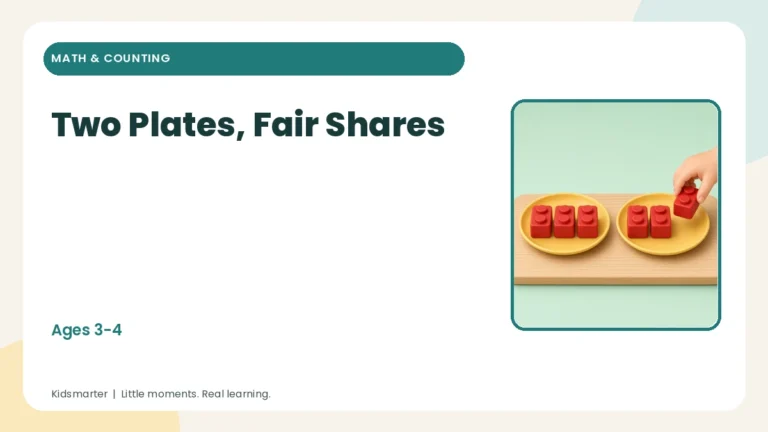
More or Fewer Picture Piles
Quick Activity Snapshot
- Age Range
- Ages 3–4
- Prep Time
- 5 minutes
- Skills Practiced
- Comparing quantities
- Materials
- Two shallow trays or spaces on a mat, Eight matching broad paper fruit pictures, only when suitable, One whole sheet of plain paper and a whole crayon for the drawn version
Age ranges are suggestions, not developmental milestones or standards. Choose the setup for this child, and stop whenever needed.
Two little picture piles can invite a surprisingly rich question: which has more? Use quantities small enough to inspect, then move the pieces around to see whether appearance tells the whole story. This is a comparison game, not a lesson about who gets a larger group.
Materials You’ll Need
- Two shallow trays or spaces on a mat
- Eight matching broad paper fruit pictures, only when suitable
- One whole sheet of plain paper and a whole crayon for the drawn version
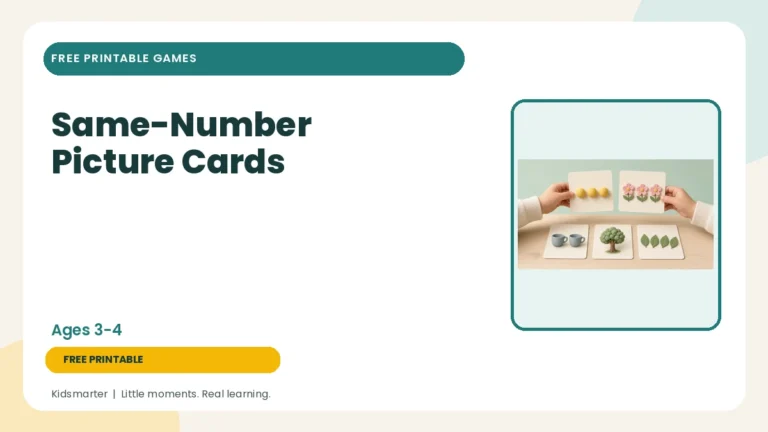
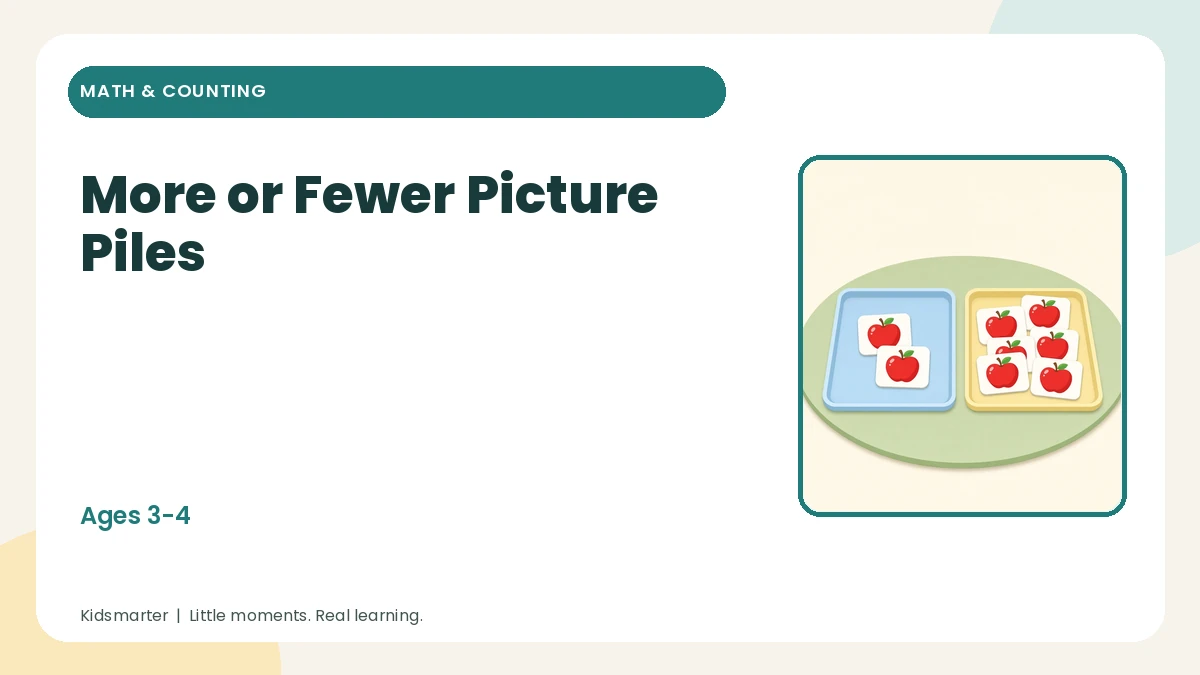
For children who handle paper without mouthing it, prepare eight matching broad fruit pictures: three in one shallow tray and five in another. No food is needed. For a no-loose-pieces version, draw three circles on the left of one whole page and five on the right. Join left and right circles with lines to make pairs. When a later step changes the groups, the adult draws a fresh diagram rather than asking the child to move ink.
Step-by-Step How to Play
-
Set the trays side by side, or point to the two groups on the intact sheet. Ask, “What do you notice?” Listen to comments about color or layout before introducing more and fewer. Neither group belongs to a particular person; this is not a question about who deserves more food.
-
Place one picture from each tray in two rows so partners face each other. Say, “This one has a partner,” and continue until the row of five has two leftovers. On the whole-sheet version, the adult draws a line between one left circle and one right circle instead of moving pieces.
-
Count each group once, touching a picture or pointing to a drawn circle for each number word. Say the total again: “Five altogether.” The three pairs and two leftovers can show which group has more even when your child prefers not to count aloud.
-
With cards, spread the three pictures out and bunch the five together. Did moving them add or remove any? Pair again to check. With drawings, an adult uses a fresh sheet to draw the same three and five in the new spacing; put the first diagram aside before counting the new one.
-
With cards, move one picture from the group of five into the group of three. Count four in each group. With the whole-sheet version, an adult draws a fresh group of four on each side and puts the old diagram aside. Put all pictures away afterward; a later snack remains a separate meal, not a prize for making equal groups.
Small Details That Make This Activity Work
Use matching pictures and shallow spaces at first so the comparison is about how many, not picture size or container depth. With three and five, pairing leaves two pictures without partners. If your child changes a group, count the new amount instead of repeating an obsolete total. In the drawing version, cross no marks out during counting: draw a fresh pair of groups so every visible circle still counts once.
Why This Activity Helps
One-to-one pairing gives a concrete basis for comparing quantities without relying only on counting words. Rearranging exposes the difference between space occupied and number of items. Preschoolers may change their answers as they investigate; that is useful information, not failure.
Easy Ways to Adapt by Age
Make It Simpler
Compare one piece with three and pair them together yourself. Let your child point to the row with leftovers rather than requiring a full spoken explanation.
Ready for a Challenge
Try two pictures and four: moving one across makes three and three. Then, if your child is curious, compare two and three. Five whole pictures cannot be split into two equal groups just by moving them; one will be left without a partner. Show that with pairing rather than expecting an equality solution for every starting pair.
Parent Tip & Safety Note
Use pictures rather than small foods. Adults prepare card pieces and remove scraps; choose drawn circles instead if the child mouths paper. Supervise younger siblings and keep all counters separate from eating surfaces. No one needs to taste, finish food, or earn a snack to answer a comparison question.
Explore more activities in this category or free printable games.