One or Two Picture Cards
Quick Activity Snapshot
- Age Range
- Ages 2–3
- Prep Time
- 5 minutes to print, plus optional cutting by an adult
- Skills Practiced
- Looking at a picture and saying whether it shows one or two of the same thing
- Materials
- The free one-or-two picture cards, a table, and an adult staying with the child
Age ranges are suggestions, not developmental milestones or standards. Choose the setup for this child, and stop whenever needed.
A printed sheet of everyday pictures can become a short counting-look job. Each card shows either one thing or two of the same thing. You point to a card and say whether you see one or two. This is not matching cards that have the same number, not finding a group of three, and not lining up four pictures.
Materials You’ll Need
- The free one-or-two picture cards from this page, printed at actual size on US Letter paper
- A clear table, and an adult staying with the child. If you want separate cards, an adult may cut them apart. The child does not need scissors
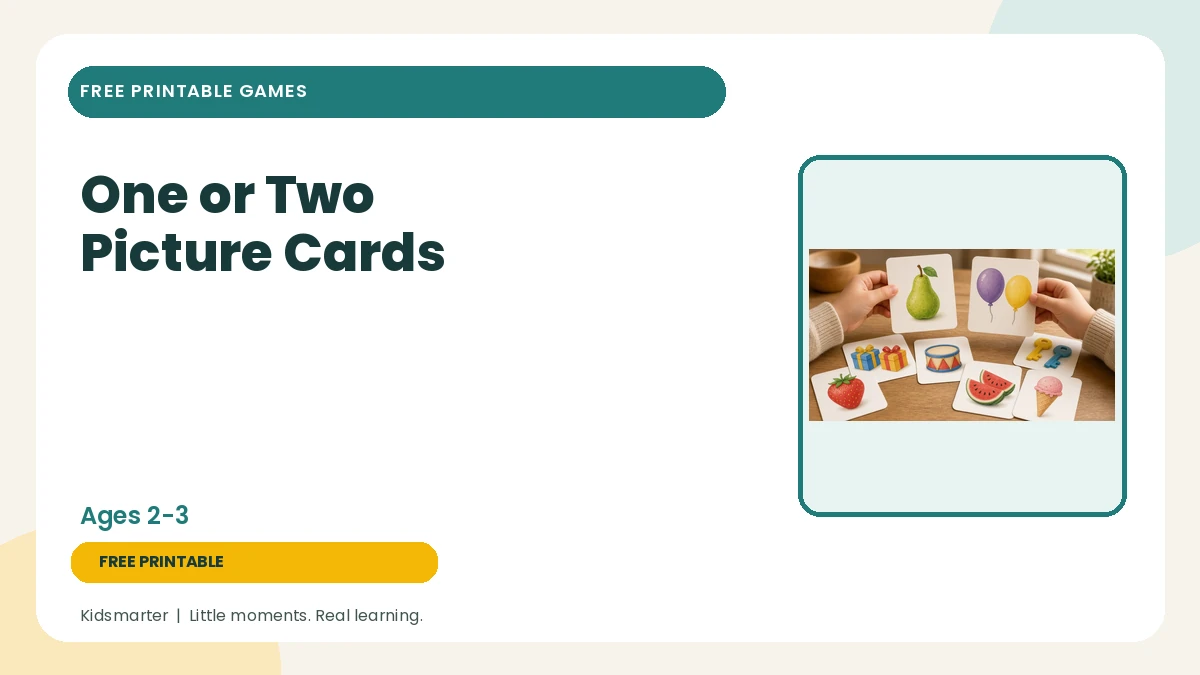
You may leave the sheet whole and point to the pictures, or an adult may cut the eight cards and then put the scissors away before the game begins. The pictures are wordless. They show one pear, two balloons, one strawberry, two gifts, one drum, two watermelon slices, one ice cream, and two toy keys. The key pictures are toy-key drawings, not real keys.
Step-by-Step How to Play
-
Set the sheet or the cards on the table. Point to one picture and say what you see, such as, “This card has one pear,” or “This card has two balloons.”
-
Invite your child to point, or to say “one” or “two.” If they only want to look, you can say the number again yourself.
-
If they still want a turn, you may point to another card and ask, “Is this one, or two?” There is no score, and you do not need to use every card.
-
Looking at a few cards can be a complete game. You do not need to sort every picture into two piles unless they ask to keep going.
Small Details That Make This Activity Work
Stay with one card at a time, so the job is noticing one or two, not matching equal amounts, not making a group of three, and not lining pictures in a row of four. Keep the talk short, and do not test a long list of other words at the same time. If they only want to look at a favorite picture, that can be enough. This is not same-number picture cards, not a group of three, not a line of four, not round or not round, not flying or walking, not wheels or no wheels, not food or clothing, and not inside or outside: the job is to say whether the picture shows one or two.
Why This Activity Helps
Looking at a clear picture and saying “one” or “two” is one everyday way to talk about how many. There is no official study cited for this homemade card set, and deciding whether a picture shows one or two is not evidence of later skill. Children may enjoy pointing to a favorite picture without saying the number.
Easy Ways to Adapt by Age
Make It Simpler
Cover all but two pictures, such as the pear and the balloons, and talk through “one” and “two.” No cutting is needed.
Ready for a Challenge
Use the cut cards, mix all eight, and let your child make a one pile and a two pile. Stop if the extra sort starts to feel like a quiz.
Download Free Printable PDF
This original US Letter page is free to download. Print at actual size. Use the whole page and point to the pictures, or let an adult cut the eight cards apart. The child does not need to cut. No email signup is required.
Parent Tip & Safety Note
Stay at the table. If you cut the cards, an adult does the cutting, then puts the scissors away before the game begins. Keep paper cards out of mouths, and do not add real keys, real balloons, real food, or other small objects to the cards. The key pictures are toy-key drawings, not real metal keys. This is a picture game, not a tasting activity, and not a game with loose small parts. Supervise as you would with any small paper pieces if a baby is nearby. Stop when your child is finished or wants to look at the pictures in another way.
Explore more activities in this category or free printable games.