Make-5 Number Bond Cards
Quick Activity Snapshot
- Age Range
- Ages 5–6
- Prep Time
- 5 minutes to print and cut
- Skills Practiced
- Number bonds to 5
- Materials
- Printed bond cards, Counters or crayons
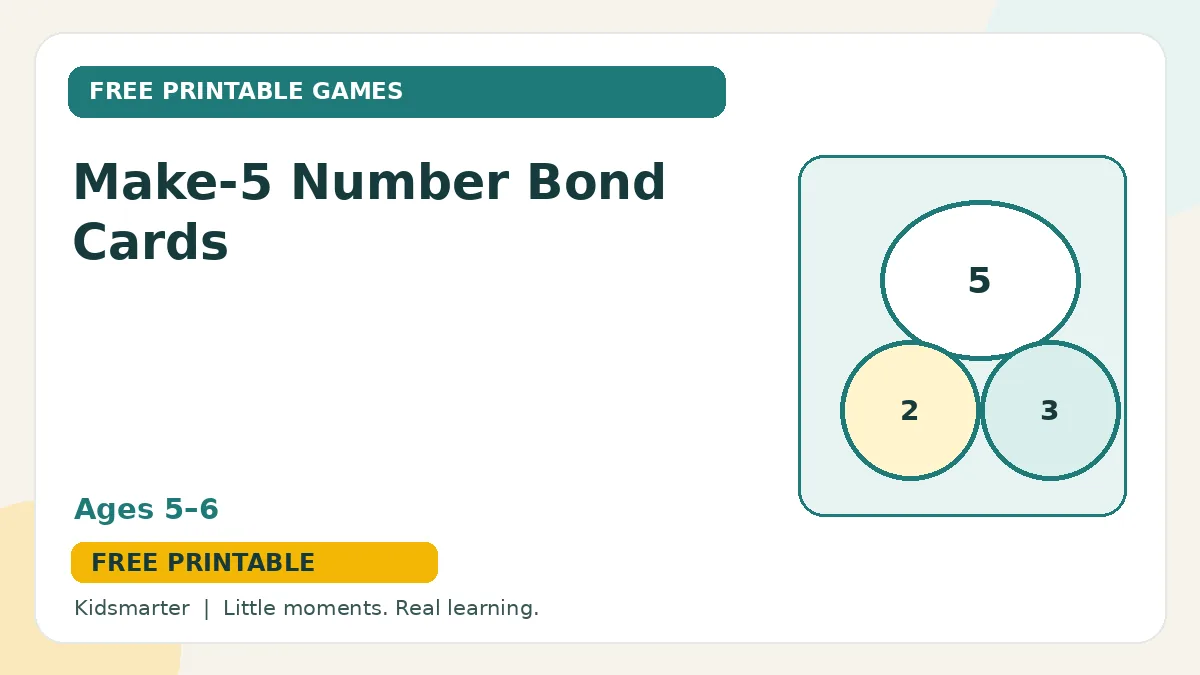
Five can be made in more than one way, and number-bond cards make those ways easy to see. Your child places counters or marks on two parts that together make five, then checks the total. Two and three, four and one, and five and zero are all welcome discoveries. The point is not to memorize a list in one sitting, but to build and rebuild five until the different partners feel familiar and checkable.
Materials You’ll Need
- Printed bond cards
- Counters or crayons
Print and cut the bond cards with adult help, and provide five counters or a crayon. Sit at a table with one card at a time. A completed example card can sit nearby as a model, and the remaining cards can stay in a small pile.
Step-by-Step How to Play
-
Show a bond card with a whole of 5 and two empty parts. Place five counters in a line and say, ‘We have five. We are going to split them into two groups.’ Move two counters into one part and three into the other, then count each part and the whole.
-
Invite your child to try a different split on the next card, such as four and one. If the two parts do not add to five, count all the counters together and adjust. The card can be checked by returning the counters to one line.
-
Try a bond that includes zero, such as five and zero, so your child can see that all five counters may sit in one part. Talk about that as a real way to make five, not as a trick question.
-
When a few bonds have been built, look at two completed cards and ask, ‘What is the same? What changed?’ You may write the numbers in the parts if your child is interested, or keep the work in counters only.
-
Finish by asking your child to show one favorite way to make five from memory, then check with the counters. Gather the cards and counters so the set stays complete for another short session.
Small Details That Make This Activity Work
If your child always builds the same split, ask for one different way and then stop, leaving a successful new bond in view. Store five counters with the pack so the next invitation can start without a hunt for pieces.
Why This Activity Helps
Number bonds show that a total of five can be composed of two parts you can build and count. Building each bond with counters keeps the idea checkable, and including zero prevents the false idea that both parts must be visible amounts greater than none. Comparing two cards helps children notice a pattern, such as one part growing while the other shrinks. The work should stay concrete long enough that the numbers on the card still mean the counters.
Easy Ways to Adapt by Age
Make It Simpler
Use a single card and five counters, and let your child move the counters while you name the parts. Begin with two and three, which many children have already seen in everyday sharing. You can also build the bond on a plain plate and then place the counters onto the card.
Ready for a Challenge
Ask your child to find every bond on the cards and line them up in an order they choose, such as 0 and 5 through 5 and 0. You may record one bond as a short number sentence after the counters have been checked, not before.
Parent Tip & Safety Note
Prefer large counters or crayon marks; do not use beads, beans, or cereal. Size is not a safety certification. Keep small cut cards away from younger siblings. An adult should cut the cards; children do not cut. If crayons are used instead of counters, keep marks light so a card can be reused, or slip the card into a reusable sleeve.
The age range above is a suggested starting point for this setup, not a developmental milestone or a standard your child must meet. Check each bond by returning all five counters to one line, and treat a new split as a fresh look at the same total of five.
Find another small invitation to play in Free Printable Games, or explore our free printable games. Choose one that fits your child’s interests, available materials, and energy today.