Spoon and Fork Dinner Patterns
Quick Activity Snapshot
- Age Range
- Ages 3–4
- Prep Time
- 4 minutes
- Skills Practiced
- Simple patterns
- Materials
- Four spoons and four blunt forks, or a whole sheet of drawn spoon/fork symbols, A stable tabletop and a towel laid flat
Age ranges are suggestions, not developmental milestones or standards. Choose the setup for this child, and stop whenever needed.
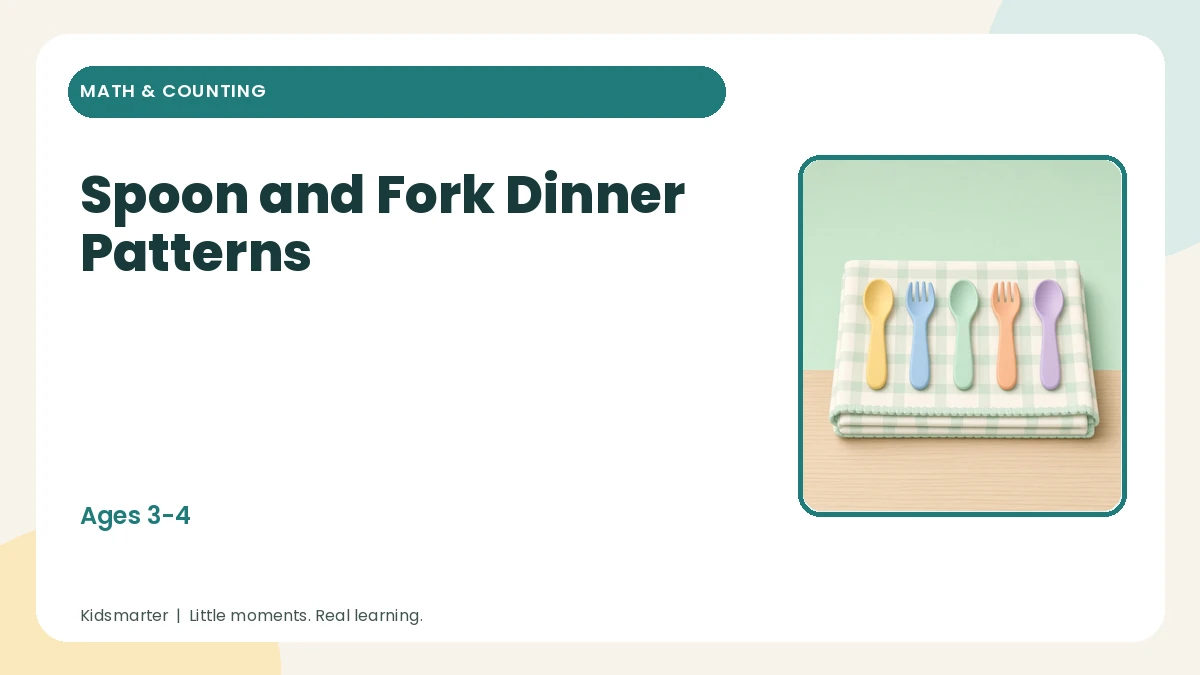
Setting the table can become a pattern workshop before dinner is ready. A spoon, a fork, another spoon: can your child hear and see the little repeat? Use blunt tableware and a clear patch of towel, and keep the first pattern very short.
Materials You’ll Need
- Four spoons and four blunt forks, or a whole sheet of drawn spoon/fork symbols
- A stable tabletop and a towel laid flat
Gather four spoons and four blunt, intact forks of similar size. Keep spare utensils on the table, away from hot food and cooking. If a child mouths utensils, waves them near faces, or wants to walk with them, put them away and draw spoon/fork symbols on one whole page instead. Your child can point to a choice while you draw the next symbol. This keeps the rule without needing cut-out tines or small cards.
Step-by-Step How to Play
-
Build spoon, fork, spoon, fork in a straight line. Point to each item while saying its name with an even rhythm. Ask your child to listen once before choosing the next utensil.
-
Offer one spoon and one fork. Say, “We have spoon, fork, spoon, fork. What would keep our pattern going?” Let your child place the choice and then read the whole line aloud together.
-
Separate the first spoon-fork pair slightly from the next. Explain, “This little pair repeats.” Grouping the repeat helps the child see a unit instead of memorizing a long string of unrelated objects.
-
Once a six-item spoon–fork row is familiar, swap its fourth and fifth objects. Read the new row slowly: spoon, fork, spoon, spoon, fork, fork. Ask, “Does this still repeat our spoon–fork pair?” If your child notices a break, swap the two objects back together. You are checking the agreed rule, not declaring the objects themselves wrong.
-
Let your child invent a row for you to extend. Ask which small group they want to repeat, then help show that group twice. A single spoon is a starting idea, not enough information to identify a repeating rule. A row of spoon, spoon, spoon does show a one-object unit repeated. Wash used utensils before returning them to meal service.
Small Details That Make This Activity Work
Copying a model and extending it are different tasks. If matching beneath your row is comfortable but choosing the next object is not, say the repeating pair together again. Separate complete pairs with a little space. For a spoon–fork–fork invention, use two spoons and four forks to show two complete repeats. Similar utensil colors keep the intended rule about type, not an accidental color sequence.
Why This Activity Helps
Repeating patterns involve recognizing a unit and anticipating its return. Naming each object aloud links the visual sequence to an audible rhythm. Understanding the repeat is different from simply copying a row in exactly the same order.
Easy Ways to Adapt by Age
Make It Simpler
Make only spoon, fork, spoon and place the next fork beside the gap. Copy a matching row underneath before asking your child to continue independently.
Ready for a Challenge
Try spoon, spoon, fork repeated twice. Ask your child to clap the same rhythm, then rebuild it with blocks. Change the objects without changing the repeating structure.
Parent Tip & Safety Note
Use no knives, sharp cocktail forks, or broken utensils. Keep the pattern away from hot food preparation. If utensils go into mouths, wash them before anyone eats; do not rely on a quick wipe.
Explore more activities in this category or free printable games.